Showing posts with label transport. Show all posts

Tuesday, January 24, 2012

Market-based instruments for international aviation and shipping as a source of climate finance

The international aviation and maritime sectors today enjoy relatively favorable tax treatment, as their fuels are not taxed and the sectors are not subject to any value-added tax or turnover tax. Nor are these fuel uses subject to any global measures to reduce their associated CO2 emissions, even though they represent at least 5 percent of the global greenhouse gas emissions. A carbon charge on fuels for international aviation and shipping equal to $25 per tonne of emitted CO2 could raise about $12 billion from aviation and about $26 billion from shipping by 2020. Market-based instruments ought to be used to raise such revenue, preferably charges based on the carbon contents of fuels. Such charges would also scale back emissions by at least 5-10 percent. Developing countries ought to be able to keep their own tax revenue, and additional compensation to them for the economic burdens of these carbon charges may be warranted. Such compensation would constitute at most 40 percent of the raised global revenue. Implementing these charges can be a challenge, especially for aviation, where a large number of bilateral air-service agreements would need to be rewritten

This paper responds to the request from the G20 to explore the potential for raising climate finance from charges on fuels used in international aviation and maritime transport—with a particular focus on minimizing the impact on low-income countries and on issues of implementation. The paper makes but does not linger on the case for introducing some form of carbon pricing in these sectors. This is widely recognized, given their growing share of emissions and their exclusion from both national fuel tax regimes and from the quantified country-level emissions targets under the 1997 Kyoto Protocol.1 In part, this reflects the difficulty of allocating emissions from sources that are internationally mobile and, moreover, arise largely in international waters and airspace.2 The focus here, instead, is on the consequences of, and possibilities for, introducing such charges.

In doing so, the paper extends the analysis of such charges by the High-level Advisory Group on Climate Change Financing to the U.N. Secretary General (AGF, 2010a and b). That analysis was focused on the revenue potential of these charges. The analysis here, consistent with the request from the G20, takes forward the debate in three main ways.

First, the paper clarifies and, where possible quantifies, the key issue of ‗incidence,‘ paying particular attention to the impact on lower income countries. Specifically, it examines whether reasonably practicable compensation rules can be found that would be sufficient to ensure that developing countries are made no worse off by the global adoption of such charges.

Second, the paper examines key challenges to implementation and reaches broad conclusions on how these might best be addressed. These range from fundamental issues of sovereignty and governance that can be no more than raised here through to questions of routine administration and legal frameworks, on which clearer views can be reached.

Third, the analysis places these charges in the context of the wider circumstances and characteristics of these sectors. It stresses that, while the sectors are commonly grouped together and do indeed have important similarities relevant to carbon pricing issues, they also have important differences, including their treatment under national tax systems.

The focus is entirely on MBIs, whether in the form of carbon taxes or emissions trading schemes (ETSs). Under the auspices of the ICAO and the IMO, and as will be summarized below, efforts are underway to reduce CO2 emissions through technical and operational measures; by, for example, efficiency improvements to new planes and ships. While constructive and important, such efforts can—as in other sectors—have only limited environmental effectiveness, and will need to be supported by carbon pricing schemes. More

World Bank. Author: Keen, Michael; Parry, Ian;Strand,Jon. Document Date: 2012/01/01.Document Type: Policy Research Working Paper. Report Number: WPS5950

Market-based instruments for international aviation and shipping as a source of climate financex

Tuesday, January 3, 2012

Cambodia Transport Sector Assessment, Strategy, and Road Map


The Southeast Asia Department of the Asian Development Bank (ADB) is systematically updating sector assessments, strategies, and road maps (ASRs)1 to better harmonize program and project planning with member countries and development partners. The preparation of this transport ASR is an integral part of project planning to ensure coordination between Cambodia’s priorities and those of ADB’s Strategy 2020 and the ADB Sustainable Transport Initiative (ADB 2010h). This sector ASR also provided the basis for dialogue between the Royal Government of Cambodia, the ADB Transport and Communications Division, and the ADB resident mission in developing the ADB country partnership strategy for 2011–2013.

The ASR on Cambodia’s transport sector focuses mainly on roads and railways, but also considers urban transport. The important role of airports and water ports is discussed as well. The report was developed primarily through consultations with the Ministry of Public Works and Transport (MPWT), which manages the national and provincial road networks and the railways; the Ministry of Rural Development (MRD), which manages rural roads; and development partners working in the transport sector.

Cambodia currently has four drivers of growth: agriculture, tourism, manufacturing (mainly garments for export), and commercial and residential construction. With the exception of agriculture, each of these sectors suffered a severe downturn during the global financial crisis of 2008–2009, and this likely contributed to an increase in poverty (ADB 2010g). Expansion and diversification of Cambodia’s drivers of growth, especially agriculture, are important development objectives for the government. 

Efficient transport is critical for economic growth. The agriculture sector relies on road and sea transport for exports; the tourism sector relies on international air carriers and road transport; the construction sector relies on water and road transport for delivering construction materials; and industry (primarily garment manufacturing) relies on road and water transport to deliver the materials needed for manufacturing and to export finished products.

The two main transport subsectors in terms of passenger and freight volumes are roads and railways (Japan International Cooperation Agency [JICA] 2006). The ports, both inland (Phnom Penh) and on the coast (Sihanoukville), play an important role in the transport sector, as do the three international airports (Phnom Penh, Siem Reap, and Sihanoukville).2 Rehabilitation and further development of the transport sector are being undertaken to improve access and connectivity, both domestically and subregionally, as part of the Greater Mekong Subregion (GMS) initiative, and regionally, as part of the road and rail connectivity objectives of the Association of Southeast Asian Nations (ASEAN).

The largest subsector is road transport. In 2007, Cambodia’s road vehicles totaled 1,066,192— 273,243 cars and light vehicles such as motorcycles and auto-rickshaws; 4,067 buses; 37,098 trucks; and 511 other vehicles (National Institute of Statistics 2008). Since 2007, the annual growth rate for all categories of vehicles has been an estimated 5.1%.

ADB.December 2011.Type: Country Planning Documents.Country: Cambodia.Subject: ADB administration and governance; Transport and ICT. ISBN:978-92-9092-413-5 (print), 978-92-9092-414-2 (web).


For more information about Projects in Cambodia see SOUTHEASTERN ASIA Projects

x

Thailand Transport Sector Assessment, Strategy, and Road Map


This sector assessment, strategy, and road map (ASR) represents the current assessment and strategic investment priorities of the Government of Thailand and the Asian Development Bank (ADB) in Thailand’s transport sector. It highlights sector performance, needs, constraints, and present government plans and strategies. The ASR will be linked to the ADB country partnership strategy (CPS) for Thailand, 2012–2016. It is also aligned with the vision and strategies of the country’s draft 11th National Economic and Social Development Plan, 2012–2016.1 This ASR may need to be updated in accordance with any changes in government policy during the finalization of the 11th Plan. This ASR focuses on three transport subsectors: (i) roads, (ii) rail, and (iii) urban transport. It is a working paper that reflects ADB’s experiences and was developed through consultations with government agencies and development partners. Key extracts of the ASR will be included in the next CPS for Thailand.

Thailand’s economy is heavily dependent on external trade, with exports representing over 60% of gross domestic product (GDP) in 2007 (footnote 1). Although economic growth has declined in recent years, from 4.8% in 2007 to –2.7% in 2009, the current global economic recovery has significantly strengthened export trade volumes. The export-dependent nature of Thailand’s economy, with recent structural changes toward a higher share of value-added manufactured goods and level of global trading, requires a strong supportive and integrated transport and trade facilitation system.

Thailand’s transport sector contributes 1% to the country’s economy. Exports contributed over 60% to Thailand’s GDP in 2007, and the transport sector underpins this notable export performance. The road subsector dominated the transport sector with an estimated 95%8 of the freight and 98% of passengers.

In terms of physical development, the road network also dominates, with an estimated total length of 202,000 kilometers (km). The length of the rail network is 4,043 km. The length of coastline is 2,614 km, and navigable inland waterways represent only about 1,750 km. Thus, the road network is the most developed, with about 98% of roads, including village access roads, being paved.

Passenger transport in Thailand is dominated by personal vehicles (primarily cars and pickup trucks) and motorcycles. National personal vehicle ownership (expressed as in-use vehicles per thousand population) was growing at an average of 8%–10% per year from 1999 to 2007, and this trend is expected to continue.

In Bangkok, cars and pickup trucks are the most prevalent, with 388 vehicles per 1,000 population, compared to 220 motorcycles per 1,000 persons. Motorcycles are dominant in areas outside of Bangkok, with 159 motorcycles and 112 cars or pickup trucks per 1,000 population. With the continuing per capita income growth, it is expected that ownership of four-wheel vehicles will grow faster than motorcycle ownership.

ADB.December 2011.Type: Country Planning Documents.Country: Thailand.Subject: ADB administration and governance; Transport and ICT. ISBN:978-92-9092-415-9 (print), 978-92-9092-416-6 (web).


For more information about Projects in Thailand see SOUTHEASTERN ASIA Projects

x

Thursday, December 15, 2011

China Hubei Xiangfan Urban Transport Project

The development objective of the Zhangjiakou Hohhot (ZhangHu) Railway Project for China is to respond to existing and anticipated transport demand along the Hohhot-Zhangjiakou corridor by providing increased capacity for freight and passengers, and faster travel time and increased frequency of services for passengers.

Some of the negative and mitigation measures include: a) the cultivated land requisitioned by the project has been contracted by each households which depend on the land to different extent, but the compensation policies have restricted flexibility in operation, the village collectivities cannot share the risk by adjusting the land again arbitrarily, thus increasing the living risk for the rural households mainly dependent on the land; and b) reduction of arable lands may make the peasants become more concerned on the maintenance and production of these lands.

The boundary of farmlands and irrigation water sources will become more sensitive issues among peasants and villages. If without proper treatment, it will directly influence the normal life of residents.

World Bank. China - Hubei Xiangfan Urban Transport Project


x

China.Guiyang Transport Project

Project Development Objective.To increase the access and mobility of Guiyang Municipality's transport users through priority infrastructure investments while establishing more sustainable mechanisms for rural road maintenance, as well as enhancing capacity for keeping municipal debt under control.

World Bank.Author Zhang,Wenlai; Document Date 2011/12/03.Document Type Implementation Status and Results Report.Report Number ISR5041


c

Friday, December 9, 2011

Colombia. Support to the Energy Efficient National Freight Transport Initiative

Road freight transportation is the main transport mode related to domestic commerce, thus becoming a major factor regarding high logistics costs that overwhelm the Colombian economy. The present TC will help assess and review sectoral public policies in cooperation with carriers and shippers. In addition will deepen the general knowledge regarding road freight transport and its impact on GHG emissions

IDB. CO-T1237 : Support to the Energy Efficient National Freight Transport Initiativex

Wednesday, December 7, 2011

Europe Union.Transport and Telecommucations.Background

Council Europe.Transport,Telecommunications and Energy Council.Brussels,7 December 2011. Establishment of a single European railway area The Council is expected to reach political agreement on a draft directive on a single European railway area (17324/11), confirming its general approach adopted in June this year, while slightly adapting the wording of a few provisions in order to take account of amendments adopted by the European Parliament. While this political agreement is being formalised in the form of a first-reading position, the Council will enter into negotiations with the European Parliament to seek agreement on a final text to be adopted jointly by both institutions at second reading, if possible.

The Council will try to reach a partial general approach on a proposal for a regulation on the tachograph to be used by professional drivers so that compliance with the rules on driving time and rest periods can be monitored, in order to ensure road safety, decent working conditions for drivers and fair competition between transport businesses. The aim of the proposal, which amends the 1985 tachograph regulation, is to make fraud more difficult and to reduce the administrative burden by making full use of new technologies and introducing a number of new regulatory measures.

The Council will take stock of progress made on new guidelines defining a long-term strategy for the trans-European transport network (TEN-T) with the aim of establishing a complete and integrated transport network covering all member states and regions and providing the basis for the balanced development of all transport modes.

The Council will seek a general approach on an update of a 2008 directive defining the minimum level of training for seafarers, with a view to aligning the EU legislation with recent amendments to the International Convention on Standards of Training, Certification and Watchkeeping for Seafarers (STCW). The 2008 directive is the transposition into EU law of this convention, which was adopted by the International Maritime Organisation (IMO) and to which all EU member states are parties.

The Council is due to agree a general approach on a recast of the 2002 regulation on the phasing-in of double-hull requirements for single-hull oil tankers (17025/11). The recast brings together the amendments made to the regulation in one text for clarity; the only change to the rules currently in force concerns the procedure for updating the references in the regulation to the relevant regulations and resolutions adopted by the International Maritime Organisation (IMO).

In a public session, the Council will adopt its position at first reading (16226/11 + ADD1) on the draft decision on the first radio spectrum policy programme. The text endorsed was negotiated in trialogue meetings between the Polish presidency, the European Parliament and the European Commission. The Council position will be transmitted to the European Parliament, which is expected to endorse it in the first quarter of 2012.

The Council will take note, in a public session, of a progress report (17900/11) on a draft roaming regulation and will have an exchange of views on the basis of the presidency questionnaire In a public session, the Council will take note of the progress report on a draft  regulation concerning the European Network and Information Security Agency (ENISA). The Commission proposal aims to strengthen and modernise the ENISA and to establish a new mandate for a period of five years.

The Council is due to adopt conclusions on the open internet and net neutrality in Europe (17904/11). These conclusions were drawn up on the basis of the Commission communication on the subject published in April 2011 (9350/11). This communication seeks to fulfil the Commission commitment to preserve "the open and neutral character of the internet, taking full account of the will of the co-legislators now to enshrine net neutrality as a policy objective and regulatory principle to be promoted by national regulatory authorities". This commitment was made in its declaration on net neutrality when the 2009 telecoms package was concluded (OJ C 308,  18.12.2009, p.2).

n

Saturday, December 3, 2011

Mongolia.Logistics Capacity Development Project

ADB's country partnership strategy for Mongolia identifies the underdeveloped transport network and inefficient logistics as major sector problems. Components: "Institutional Plan for supporting logistics network development."Capacity development for managing logistics centers."Financing strategy for attracting private sector participation in logistics development 

Asian Development Bank.Project Number.45264-01

Logistics Capacity Development Project : Mongolia

Wednesday, November 30, 2011

China.Hubei Xiangfan Urban Transport Project

This Hubei Xiangfan Urban Transport Project aims to establish a complete traffic network system in Panggong Subdistrict, promote the development of this district, and improve the public transport system in Xiangyang city, enhance the capability of traffic management organizations and improve traffic control.
Negative impacts include: loss of farm land, loss of houses, loss of employment, loss of crops, and loss of trees. Mitigation measures include: 1) providing compensation for the loss of properties like houses; 2) providing living rehabilitation allowance for compensating the temporary impacts on the life and social activities of displaced persons; 3) providing the persons losing means of subsistence with capital and enterprise support through employing or training for restoring their incomes; 4) providing affected communities with communality facilities and services; and 5) the persons losing farmland due to the project construction are entitled to enjoying directly obtaining land compensation fees, resettlement allowance and young crops compensation fees.
If the land is occupied temporarily, the loss of young crops, income loss, infrastructure damage and re-cultivation cost arising there from should be compensated accordingly
China - Hubei Xiangfan Urban Transport Project : resettlement plan (Vol. 4 of 4) : Resettlement action planas

Tuesday, November 29, 2011

Colombia.Support to the Energy Efficient National Freight Transport Initiative

Road freight transportation is the main transport mode related to domestic commerce, thus becoming a major factor regarding high logistics costs that overwhelm the Colombian economy. The present TC will help assess and review sectoral public policies in cooperation with carriers and shippers. In addition will deepen the general knowledge regarding road freight transport and its impact on GHG emissions

CO-T1237:Support to the Energy Efficient National Freight Transport Initiativea

Wednesday, November 23, 2011

Uruguay.Transport Infrastructure Proyect

The Government of Uruguay has a long term vision to place Uruguay as a regional logistic platform; the country has been developing into a regional hub for the Southern Cone for the last two decades. Uruguay's attractiveness as a logistics hub is due to several factors, including its strategic location and an enabling free-trade-zone legislation.

Author: Gauthier,Gregoire Francois.Document Date:2011/11/23.Document Type:Project Information Document.Report Number:PIDC60

Tuesday, November 22, 2011

China.Hubei Xiangyang Urban Transport Project

China's dramatic economic growth over the past twenty years has been accompanied by unprecedented urbanization. The urban population has increased from less than 25 percent of the total in1985 to 46.5 percent in 2009. The Government expects 20 million people to migrate from the countryside to urban areas each year for the next 20 years. Rapid growth in urban areas combined with a restructuring of the economy has led to large and growing urban transport challenges.

Economic growth and urbanization have not occurred uniformly: a number of coastal cities and major regional economic centers (often the provincial capitals) have absorbed a large percentage of economic and urban growth, while smaller cities in the hinterland have developed more slowly.

In recent years, however, urban growth has picked up Western China, and many inland cities have started facing many of the challenges that major coastal city centers (e.g., Beijng, Shanghai) had experienced in the earlier phases of their rapid development. The most notable challenge is a rapid rise in motorization rates leading to increased congestion, deteriorated performance of public transport service, degraded air quality, and rising traffic accidents and fatalities.

World Bank. Author. Fang,Ke. Document Date 2011/11/22.Document Type: Project Information Document. Report Number: PIDA99. Country: China.Disclosure Date. 2011/11/22. Doc Name.Project Information Document (Appraisal Stage). Hubei Xiangyang Urban Transport.P119071. Language English. Rel.Proj ID. CN-Hubei Xiangyang Urban Transport. P119071
 

Thursday, November 17, 2011

China: urban accessibility planning support systems with a case study in Wuhan

Increasing accessibility bringing people, opportunities and goods within easy reach of each other has always been the fundamental role of cities. In the past, policy makers often analyzed the transport system using metrics that focused on mobility the ease of movement in a city. The most prominent of these metrics is congestion, often expressed as the ratio of road speeds between congested and uncongested conditions.

A recent Brookings Institution report on accessibility aptly summarizes the shortcomings of this metric in analyzing the performance of the urban transport-land use system. Clearly, using mobility metrics that focus on travel speeds alone tends to exclude a crucial component of urban system dynamics the interactions between the land use functions and the transport systems in a city. Several policy scenarios along these lines of particular pertinence for the pilot city of Wuhan were analyzed as part of this study.

Accessibility metrics that consider both the ease of movement on the transport system and the corresponding number of destinations reached are not entirely new. This project is the latest in a series of research efforts that the Bank has supported in recent years that focus on measuring accessibility in Chinese cities. First, the World Bank supported analytical work that compares pedestrian access to jobs and commercial opportunities in the central business districts of Beijing, London and New York. This document is a brief summary of the latest work completed in this series.

The document provides a description of a pilot project in Wuhan, China to demonstrate the value of accessibility metrics in the urban planning decision making process, including a description of the tools used and policy lessons generated. The primary purpose of the exercise was to demonstrate the practical applications of these tools for use in understanding transport/land use dynamics in World Bank client cities.

World Bank.Document Date 2011/11/16. Document Type ESMAP Paper.Report Number 65620. Volume No 1 of 1

Tuesday, November 15, 2011

China.Hubei Xiangyang Urban Transport Project: environmental assessment

This Hubei Xiangfan Urban Transport Project aims to establish a complete traffic network system in Panggong Subdistrict, promote the development of this district, and improve the public transport system in Xiangyang city, enhance the capability of traffic management organizations and improve traffic control.

Negative impacts include: impacts on social environment through implementing relevant policies, impacts of the project construction on social environment, influence ambient air quality, influences on surrounding residents, schools and hospitals, pollutions from construction activity are discharged into surface water body, influence on health, and influence on the fauna and flora.

Mitigation measures include: 1) strictly control the working area of construction and avoid widening the construction site without authorization; 2) install the separating wall around the construction site; 3) it is required to prepare one watering car at least for each construction site. The spraying frequency will be determined according to the weather condition; 4) low-noise mechanical equipments or equipments with sound insulation or sound reduction should be selected; 5) during the periods of college and high school entrance examination, it is forbidden to take out the construction around schools; 6) it is prohibited to allow the construction activity inside the bank of Hanjiang River; and 7) domestic waste should be stored at fixed points, daily cleaned up

CN-Hubei Xiangyang Urban Transport -- P119071; Document Date.2011/11/01.Document Type:Environmental Assessment.Report Number E2868

Monday, November 14, 2011

Chile - Santiago Urban Transport Technical Assistance Project

The objective of the Santiago Urban Transport Technical Assistance Project for Chile is to support the Borrower in achieving an efficient and sustainable urban transport system for Metropolitan Santiago.

The restructuring includes: (i) cancelling US$1,440,439 of the loan amount because some project activities have been and will still be fully or partially financed with local funds; (ii) revising the withdrawal schedule to reflect the partial loan cancellation and reallocate funds between expenditure categories; and (iii) revising the project costs and the financing plan accordingly.

Latin America.RG-T2033: LAC Transport Megaprojects Strategy

This KCP intends to address the challenge of the implementation of transport megaprojects, whose demand is likely to increase in response to the mandates of the Ninth General Capital Increase (GCI-9) lending targets and institutional priorities. It will promote knowledge exchange activities and will provide the basis for a transport megaprojects strategy.

Inter American Development Bank

Tuesday, November 8, 2011

China-Xinjiang Yining Urban Transport Improvement Project

Yining proposed to the Bank team a package of urban transport investments, including the construction of new roads and improvement of existing roads, the provision of public transport infrastructure and services, and the improvement of traffic management and road safety.
According to the proposal and the Bank team#s assessment, it is proposed that the focus of the project is to provide the basic urban transport infrastructure and equipments to support the socialand economic development of Yining, meanwhile introducing modern traffic management concept and techniques to ensure the sustainability of development.

Yining´s existing central city area has a relatively adequate urban road network, but their functioning is being compromised by the severe deterioration and the lack of Non MotorizedTransport (NMT) facilities or auxiliary facilities such as lighting and greening. It is recommended that these roads should be rehabilitated to improve the living conditions of the local residents.

The two new development zones to the east and west of the existing city area are rapidly growing, thus new roads are needed to support their development. However, the road function should be well-defined to determine the cross section design instead of simply building wide roads as proposed by the city.

Public transport service in Yining is far from being attractive and convenient. There are only 14 bus lines in operation and 299 buses in total, many of which are rather decrepit. Insufficient public transport facilities are another constraint to the further development of public transport in Yining. Moreover, the city currently has no advanced systems for bus ticketing, dispatching or operation.

Traffic management capacity is relatively low, leading to the under-utilization of the existing road capacity and causing safety issues. Even with a small number of vehicle ownership of about 50,000, the city is starting to face congestions. A high fatality rate of 107 fatalities per million population is registered in 2010.

In response to these challenges, the Bank revised the proposal with Yining and tentatively agreed that the project will include the following 4 components.
Document Date. 2011/11/03.Document Type.Integrated Safeguards Data Sheet.Report Number.AC6497.Volume No 1 of 1

Complete Report
Official version of document (may contain signatures, etc)

Thursday, November 3, 2011

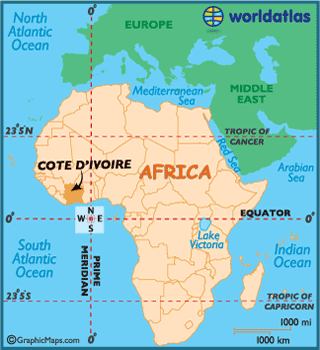
Cote d'Ivoire's Infrastructure: a continental perspective

Infrastructure contributed 1.8 percentage points to Cote d'Ivoire's annual per capita GDP growth over the mid-2000s before conflict began to erase the country's infrastructure and its growth contributions. Raising the country's infrastructure endowment to the level of the region's middle-income countries could boost the growth rate by a further 2 percentage points.

Private sector contracts signed in the 1990s resulted in improved operational performance and funding for investments in the water, power, transport, and ICT sectors. Impressively, those contracts survived the crisis and delivered uninterrupted service. But private investment flows have decreased since the mid-2000s. Cote d'Ivoire's most pressing infrastructural challenge will be to regain the financial equilibrium needed to restore a reliable energy supply. Reestablishing the prominence of Abidjan's port will require investments in terminal capacity and road and rail infrastructure upgrades on hinterland linkages. The underfunding of road maintenance and poor sanitation are additional challenges.

Cote d'Ivoire's annual infrastructure spending was $750 million in the mid-2000s, with going to power sector operations and maintenance. If the underpricing of power and other inefficiencies (valued at $200 million annually) were eliminated, the country’s annual infrastructure funding gap would amount to $1 billion, and infrastructure goals could be reached within 20 years. Cote d'Ivoire's has relatively good prospects for bridging its funding gap by raising public investment from its low current level, choosing more efficient technologies, and harnessing additional private investment for infrastructure.

Author: Foster, Vivien; Pushak,Nataliya;Document Date: 2011/03/01.Document Type: Policy Research Working Paper.Report Number: WPS5594.Volume No: 1 of 1. Disclosure Date:  2011/03/01

<><>

Text Version*
<><>