Showing posts with label trade. Show all posts

Thursday, January 12, 2012

Landlocked or policy locked ? how services trade protection deepens economic isolation


A new cross-country database on services policy reveals a perverse pattern: many landlocked countries restrict trade in the very services that connect them with the rest of the world. On average, telecommunications and air-transport policies are significantly more restrictive in landlocked countries than elsewhere. The phenomenon is most starkly visible in Sub-Saharan Africa and is associated with lower levels of political accountability. 

This paper finds evidence that these policies lead to more concentrated market structures and more limited access to services than these countries would otherwise have, even after taking into account the influence of geography and incomes, and the possibility that policy is endogenous. Even moderate liberalization in these sectors could lead to an increase of cellular subscriptions by 7 percentage points and a 20-percent increase in the number of flights. Policies in other countries, industrial and developing alike, also limit competition in international transport services. Hence, "trade-facilitating" investments under various "aid-for-trade" initiatives are likely to earn a low return unless they are accompanied by meaningful reform in these services sectors.

Landlocked countries are seen as victims of geography, insulated from beneficial flows of trade, tourism and knowledge. But are these countries choosing policies to offset the handicap of location and improve connectivity with the rest of the world? Surprisingly, many are not. Drawing upon a new services policy database, we show that the policies of landlocked countries in key “linking” services like transport and telecommunications are on average significantly more restrictive than elsewhere. We also show that these policies lead to more concentrated market structures and more limited access to services than these countries would otherwise have, even taking into account the constraining influences of geography and low incomes, and the possibility that policies are endogenous.

To motivate the analysis, consider three landlocked countries, Laos, Nepal and Zambia, on which we provide more detailed information in Section 2. In terms of policy, each country has at least until recently stifled competition in telecommunications – primarily by restricting the conditions for new entry – and in air transport – primarily by negotiating restrictive BASAs on key routes. In terms of access and quality of services, each of the three countries fairs poorly. In, Nepal the number of telephone mainlines per 100 people is 2.5, half the regional average for South Asia; in Laos 1.5, one-seventh the regional average for East Asia; and in Zambia 0.75, one-fourth of the regional average for Sub-Saharan Africa. In mobile telephony, the gaps are slightly less stark but still significant; for example, Nepal had a mobile teledensity (subscriptions per 100 people) of 12, which is about one-third of the South Asian regional average. In terms of lead time to import and export, in all three countries goods move slowly compared to their respective regional averages. For example, in Laos, shipments take twice as long for the average East Asian country (50 vs 25 days). The World Bank’s logistics performance index for the quality of logistics services is also below the regional average in all three countries.

Can concentrated markets and poor performance be attributed to poor policy? Or are they primarily attributable to other disadvantages? It is not easy to provide a convincing answer to these questions because the policy information we have collected is only for a single time period, making it difficult to control for all the possible sources of heterogeneous performance across countries. Nevertheless, we are able to control for the most likely determinants of poor performance: the adverse influences of geography and low incomes. We also address the possibility that policy itself is endogenously determined – e.g. through successful lobbying for protection by concentrated industries – by using an instrumental variable strategy that relies on the association between poor policy and weak governance. Using these strategies, we show that there is evidence that poor policies lead to more concentrated market structures and more limited access to services than these countries would otherwise have. At this stage, we seek primarily to document the unexpected patterns of policy, and demonstrate, to the limited extent allowed by available data, that these patterns matter.

World Bank. Author: Borchert, Ingo; Gootiiz, Batshur ; Grover, Arti; Mattoo, Aaditya. Document Date: 2012/01/01. Document Type: Policy Research Working Paper. Report Number: WPS5942 


x

Monday, January 2, 2012

Assessing real exchange rate misalignments


There is a renewed debate on the role of exchange rate policies as an industrial policy tool in both academic and policy circles. Policy practitioners usually examine real exchange rate misalignments to monitor the behavior of this key relative price and, if possible, exploit distortions in the traded and non-traded relative price to promote growth. 

Anecdotal evidence shows that some countries have pursued very active exchange rate policies to promote the export sector and enhance growth by undervaluing their currencies. The main goal of this paper is to provide a systematic characterization of real exchange rate undervaluations. The long-run real exchange rate equation is estimated using: (a) Johansen time series cointegration estimates, and (b) pooled mean group estimates for non-stationary panel data. The paper constructs a dataset of real undervaluation episodes. 

It first evaluates whether (and if so, to what extent) economic policies can be used to either cause or sustain real undervaluations. In this context the paper empirically models the likelihood and magnitude of sustaining real exchange rate undervaluations by examining their link to policy instruments (such as exchange rate regimes and capital controls, among other policies) using probit and Tobit models. 

Finally, it investigates whether foreign exchange intervention can generate persistent real exchange rate deviations from equilibrium. In general, it finds that intervention can lead to greater persistence in the incidence and magnitude of real exchange rate undervaluations.

World Bank. Author:Kubota, Megumi. Document Date:2011/12/01.Document Type:Policy Research Working Paper.Report Number: WPS5925.


x

Monday, December 5, 2011

The time cost of documents to trade

This paper analyzes the relationship between the number of documents required to export and import and the time it takes to complete all procedures to trade. It shows that an increase in the number of documents required for export and import tends to increase the time cost of shipments. However, this relationship is far from simplistic, varying sharply in magnitude across rich versus poor countries and small versus large countries. Specifically, the increase in the time cost of increased documentation is much larger for relatively poor and larger countries.
One interpretation of this finding is that richer countries that have more resources and smaller countries that rely more on trade invest more in building efficient documentation systems. Hence, in such countries relative to others, increased documentation adds less to the time cost at the margin. At a broader level, the findings suggest caution in interpreting how input-based measures such as the number of required documents to trade affect the quality of the business environment as far as the associated cost is concerned.
Author:Amin, Mohammad.Document Date:2011/12/01.Document Type: Policy Research Working Paper.Report Number: WPS5894.Volume No: 1 of 1
The time cost of documents to trade

Tuesday, November 22, 2011

International trade and inclusive growth: a primer for busy policy analysts

This note provides two analytical frameworks for understanding the role of trade in promoting inclusive growth in developing economies. A working definition of inclusive growth focuses on long-term, sustained growth associated with productivity growth and employment opportunities for broad portions of households and firms within countries.

International integration can promote inclusive growth when workers and firms are able to adjust to enter into growing economic activities and adopt technologies availed through international trade. The frameworks described in this note build on simple household and firm choice models, which require only basic knowledge of development economics.

The discussion highlights how these frameworks can help analysts focus on research and policy questions related to the impacts of international trade across the distribution of households and firms within countries. It also discusses publicly available data sets that can be used to explore some aspects of inclusive growth. In addition, the note highlights important caveats that need to be acknowledged by analysts and discusses avenues for future research, which needs to be part and parcel of the inclusive growth agenda

World Bank. Author:Lederman,Daniel.Document Date: 2011/11/01.Document Type: Policy Research Working Paper.Report Number: WPS5886.Volume No: 1 of 1

Friday, November 18, 2011

Reformas legales e institucionales en la implementación de acuerdos comerciales:la experiencia chilena

Chile, hace ya más de tres décadas, optó por una economía abierta, competitiva y orientada al libre comercio, disciplinada en el acatamiento de las normativas internacionales y con una política comercial compatible con la rigurosidad en la gestión macroeconómica.

Entre los años 2002 y 2004 Chile vivió una etapa acelerada en cuanto a la liberalización bilateral normada por acuerdos de libre comercio: en noviembre de 2002 se firmó el Acuerdo de Asociación Política y Comercial con la Unión Europea. Previamente habían concluido exitosamente las negociaciones con Corea del Sur y Estados Unidos, con la firma de ambos tratados en febrero y junio, respectivamente. Asimismo, en junio de 2003 Chile y la Asociación Europea del Libre Comercio (EFTA) finalizaron las negociaciones para firmar un Tratado de Libre Comercio. El año 2006 entraron en vigencia dos acuerdos económicos de suma relevancia, uno es el P-4 conformado, además de Chile, por Nueva Zelanda, Singapur y Brunei, un acuerdo pionero en lo que respecta a la transferencia tecnológica y capital humano. El otro es el acuerdo con China, un hito particularmente relevante, puesto que se trata del primer acuerdo comercial de China con un país occidental, lo que permite a Chile posicionarse como un socio preferencial para el comercio con la potencia asiática.

De esta manera, Chile ha firmado más de 20 acuerdos comerciales, con aproximadamente 60 países, logrando así un arancel cero con prácticamente 90% de su comercio, lo cual permite a una economía pequeña como la chilena competir en el mercado global. La implementación de estos acuerdos comerciales requiere de un conjunto de intervenciones gubernamentales en materia institucional, regulatoria y operativa/administrativa, que permitan su puesta en práctica en el ordenamiento jurídico nacional.

El presente documento se propone dar a conocer la forma en que el Estado de Chile ha abordado estas tareas, describiendo el marco constitucional que regula la forma en que estos acuerdos comerciales son incluidos en la normativa vigente, para en seguida analizar la institucionalidad creada al interior del Poder Ejecutivo para hacerse cargo de estas labores, así como los más recientes esfuerzos normativos para seguir adecuando esta estructura a las reales demandas actuales, lo que incluye un importante esfuerzo público-privado con este fin. Asimismo, este trabajo aborda la temática de la administración de los acuerdos comerciales como vía para lograr la implementación plena y coherente de los compromisos asumidos por los Estados signatarios.

Se trabajará principalmente en torno a dos modelos: aquel consagrado en el Acuerdo de Asociación entre Chile y la Unión Europea, y el modelo del Tratado de Libre Comercio de América del Norte (TLCAN o NAFTA, por su sigla en inglés), en los cuales se analizarán los acuerdos comerciales suscritos con Canadá y con Estados Unidos de América.

Finalmente, utilizando como base los informes sectoriales preparados por cada uno de los siete investigadores autores de este trabajo1, se extraen algunas lecciones que merecen ser destacadas en el proceso de implementación llevado a cabo por Chile.

Esteban Tomic y Rodrigo Novoa.Banco Interamericano de Desarrollo Sector de Integración y Comercio.DOCUMENTO DE POLÍTICAS #IDB-PB-124. Agosto 2011

Monday, November 14, 2011

WTO Trade Policy Review: Ecuador

The second review of the trade policies and practices of Ecuador takes place on 14 and 16 November 2011. The basis for the review is a report by the WTO Secretariat and a report by the Government of Ecuador

Secretariat report A detailed report written independently by the WTO Secretariat.

Addressing the Implementation of Prefential Trade Agreements.The Law and Pratice of the European Union-MJS

Like most industrialized countries, the European Union (EU) has concluded trade agreements with selected countries with a view to liberalize trade among those countries. In most cases, the objectives of these agreements are rather ambitious. Objectives may be the establishment of an all-inclusive custom union, such as the one with Turkey, or a full association that facilitates accession to the European Union, such as the one with the Balkan countries.

Other objectives include the establishment of a comprehensive economic partnership with developing countries in order to foster their sustainable economic development, such as the case of the African, Caribbean, and Pacific (ACP) Group of States. In Latin America association and partnership agreements have been concluded with Mexico and Chile.

A Free Trade Agreement was recently concluded with Colombia and Peru. Negotiations for an Association Agreement were concluded with Central American countries4 and were revived with the Mercosur countries during the last EU-Latin America Summit in Madrid in May 2010.Trade agreements imply preferential trade treatment among the parties. As such, they must in principle meet the conditions of Articles XXIV of GATT and V of GATS. This means that an agreement must provide for reciprocal trade benefits for substantially all trade in goods between the parties, and it must have substantial sectoral coverage in relation to services. It can apply to selected countries as opposed to others. Trade preferences are also possible under the Enabling Clause. While in this case reciprocal trade benefits are not required, the preferences must be granted to developing countries only, and no discretionary selection of them is possible otherwise than through objective criteria.

It is the policy of the EU to only negotiate reciprocal trade agreements that match the requirements of Articles XXIV of GATT and V of GATS. Under the Enabling Clause, the EU only maintains a unilateral scheme of generalized tariff preferences.8 The time when the EU would conclude trade agreements with chosen countries, thereby granting them unilateral trade preferences, is over since this would clearly violate the GATT, the GATS, and the Enabling Clause.

For instance, the trade chapter of the Cotonou Agreement, which reserved important unilateral preferences to the ACP states, was authorized until it was covered by a special WTO waiver.However, the latter expired on 1 January 2008. Therefore the Cotonou trade preferences had to be reciprocated to the EU for ―substantially all trade‖ in order to be maintained. The expected expiration of the waiver entailed the 2002 launch of a new round of negotiations with the ACP states in order to determine the pace of their own trade liberalization towards the EU. The process is laborious and is still ongoing. The only comprehensive Economic Partnership Agreement (EPA) that has been concluded is that with the CARICOM countries and the Dominican Republic (the EU-CARIFORUM EPA).11 For the rest, the EU has concluded interim economic partnership agreements (Interim EPAs) with certain individual ACP states, while pursuing negotiations for comprehensive EPAs at sub-regional levels.

The EU’s reciprocal trade agreements generally encompass two aspects, in addition to a commitment to institutionalize and intensify political dialogue. The first aspect concerns the trade arrangements between the parties and tends to be very mercantilist in nature. The purpose of the agreement is to maintain the negotiated balance of tariff rights and concessions between the parties and the services commitments, when they exist. The second aspect concerns the provisions that are meant to proactively contribute to the economic development of the EU’s partners and in certain cases, facilitate their accession to the EU. These provisions relate to the EU’s neighborhood or development policy towards non-EU countries. In this context, the trade preferences constitute merely one part of a larger political objective, and care must be taken to ensure that the agreements themselves do not undermine that objective.

For instance, the stated objective of the Stabilisation and Association Agreements with the Balkan countries are to (1)―ensure peace and stability in the region by providing support for the strengthening of democracy and the rule of law and the development of a market economy;(2) to encourage reforms with a view to accession to the EU; and (3) to foster trade relations atregional level in the Balkans and with the EU. This type of Agreement entails a progressive alignment of the legislation of the countries concerned with that of the Community

David Luff. Addressing the Implementation of Prefential Trade Agreements.The Law and Pratice of the European Union-MJS.September 2011.Inter-American Development Bank.

The Inter-American Development Bank Policy Briefs present a particular policy issue and outline courses of action, including specific policy recommendations. The information and opinions presented in these publications are entirely those of the author(s), and no endorsement by the Inter-American Developme Bank, its Board of Executive Directors, or the countries they represent is expressed or implied. This paper may be freely reproduced provided credit is given to the Inter-American Development Bank.

Thursday, November 10, 2011

WTO:Working Party seals the deal on Russia’s membership negotiations

Russia’s accession to the WTO cleared a major hurdle when the WTO Working Party on its accession approved, ad referendum on 10 November 2011, the package spelling out Russia’s terms of entry to the organization. The Working Party will now send its accession recommendation to the 15 —17 December Ministerial Conference, where Ministers are expected to approve the documents and accept Russia as a WTO Member.

On 10 November 2011, the Working Party on Russia’s accession, chaired by Ambassador Stefán Jóhannesson (Iceland), agreed, ad referendum, on the terms of the country’s membership to the WTO by adopting the package containing reforms to Russia’s trade regime, and the commitments that Russia undertook to implement as part of its WTO accession.

“It has been a long journey, but today Russia has taken a big step towards its destination of membership in the WTO. In acceding to the WTO, Russia embraces a series of rules and commitments that are the foundation of an open, transparent and non-discriminatory global trading system. This system provides important guarantees for Russia and for the 153 other Members of our organization. This win-win result will bring Russia more firmly into the global economy and make it a more attractive place to do business. For the WTO, it comes as a most welcome deliverable for the upcoming WTO Ministerial Conference and signals anew the relevance and vibrancy of the WTO as an instrument for international co-operation,” said Director-General Pascal Lamy.

“It is gratifying to see that after 18 years of sometimes uneasy negotiations the process of WTO accession is completed today. The agreement as negotiated brings us into the system of multilateral trading rules, creating new opportunities for our traders and investors and enabling us to protect their commercial interests even more effectively than before,” said Maxim Medvedkov, chief negotiator for the Russian Federation.

“The completion of this Working Party’s activity represents an historic achievement for the WTO. I am convinced that Russia’s accession to the WTO will bring substantial benefits both to Russia and to the Members of this organization. In these difficult economic times, this represents good news and I have no doubt that Russia joining our WTO family will strengthen the multilateral trading system and enhance global economic cooperation,” said Working Party Chairman Ambassador Jóhannesson.

Wednesday, November 9, 2011

People's Republic of China and Latin America and the Caribbean. Ushering in a new era in the economic and trade relationship

This document focuses on recent developments in trade between China and the Latin American and Caribbean region with respect to countries, sectors and goods, as well as Chinese foreign direct investment (FDI) in the region.

Attention is drawn to the important role China has played in the past few years as an importer of products from Latin America and the Caribbean, particularly in the context of the general slowdown of the region's exports during 2009. The analysis also confirms the essentially inter-industrial relationship between China and the region, which is based on China exporting manufactured goods and Latin America and the Caribbean exporting raw materials. This complicates not only potential business alliances between China and Latin America but also efforts to integrate the region's countries more effectively into Asia-Pacific production chains, which are organized along more intra-industrial lines.

China's demand for raw materials presents a tremendous opportunity for the region, particularly South American economies. This is a favourable trade cycle that will likely transcend many individual administrations. The challenge is, then, how the region may best tap this historic opportunity to make the investments in infrastructure, innovation and human resources needed to convert the gains derived from natural resources into human, physical and institutional capital that can underpin greater productivity and competitiveness. This will allow for greater export diversification through a deliberate, sustained effort to add knowledge and value to products. Another important challenge is to attract higher levels of Chinese FDI in Latin America and the Caribbean, especially investment directed towards improving infrastructure, promoting diversification of production and encouraging interregional business partnerships. This requires a regionally cohesive approach to China to overcome the limitations of any individual country's efforts.

For the past few years ECLAC has followed and supported activities carried out to strengthen the ties between Latin America and the Caribbean and Asia-Pacific, particularly in relation to China. ECLAC has participated in many business summits between China and the region, including the first China-Latin America and the Caribbean Think-Tank Forum, held in Beijing, and in the five ministerial meetings of the Latin American Pacific Basin Initiative. This publication is intended to lend further support to ongoing efforts to strengthen ties between the Latin American and Caribbean region and Asia-Pacific ?the most dynamic region in the world.

This publication is an updated and more detailed version of a document prepared by the United Nations Economic Commission for Latin America and the Caribbean (ECLAC) for the visit of the President of the People's Republic of China, Hu Jintao, to Brazil in May 2010. The present document has been prepared in anticipation of the visit of Vice-President Xi Jinping to ECLAC. It seeks to contribute to the overall analysis of the current and future significance of the increasing ties between the region and China.
 

World Bank.China Technology Needs Assessment

The proposed project development objective is to enhance client capacity to assess climate mitigation and adaptation technology needs and adopt global best practices.

Project Description [from section 3 of PCN]
Component 1: Technical Oversight, Synthesis and Dissemination. This component will support technical oversight and results synthesis of the technology assessments. An important component of this task will be peer review of the assessment methodologies and the sector level results. This component will also provide an outlet for dissemination through a series of workshops coordinating the steering committee and other stakeholders.

Component 2: Technology Assessments at the Sector and Provincial Levels. This component will support technology assessments of identified mitigation and adaptation sectors and several provinces.

Component 3: Capacity Building to Support Climate Technology Networks, TNA, and Technology Transfer. This component will consist of capacity building activities to support one national center, two sectoral centers, and five provincial networks with their own climate technology databases and personnel to serve as knowledge hubs in their respective areas. It will also include capacity building activities to better understand technology transfer mechanisms and the barriers to timely and widespread deployment of global best practice options.

Component 4: Project Management Office. This component will support the establishment and operation of the Project Management Office (PMO).

Project location (if known).
China, nationwide.

Borrower’s Institutional Capacity for Safeguard Policies [from PCN] The Government of China, through the Division of International Policy and Negotiations of NDRC and the national GEF focal point, has requested US$ 5 million from the Global Environment Facility (GEF) to contribute to its own TNA. As one of the main counterparts of the Bank at the central level, NDRC is familiar with Bank's safeguard policies and procedures.

Document Date: 2011/11/08.Document Type:Integrated Safeguards Data Sheet.Report Number: AC5386. Volume No:1

doc
Click here to see PDF filePDF3 pagesOfficial Version[0.21 mb]
Click here to see text fileTextText Version*

Sunday, November 6, 2011

U.S.-Peru Trade Promotion Agreement

On April 12, 2006, the United States and Peru (the "Parties")  signed the United States-Peru Trade Promotion Agreement ("PTPA" or "Agreement"), and on June 24 and June 25, 2007, the Parties signed a protocol amending the Agreement. The stated objectives of the PTPA include: strengthening the special bonds of friendship and cooperation between the Parties and promoting regional economic integration; promoting broad-based economic development in order to reduce poverty and generate opportunities for sustainable economic alternatives to drug-crop production; creating new employment opportunities and improving labor conditions and living standards in the Parties;establishing clear and mutually advantageous rules governing trade between the Parties; ensuring a predictable legal and commercial framework for business and investment; fostering creativity and innovation and promoting trade in the innovative sections of the Parties' economies; promoting transparency and preventing and combating corruption, including bribery, in international trade and investment; protecting, enhancing, and enforcing basic workers' rights, and strengthening cooperation on labor matters; implementing the Agreement in a manner consistent with environmental protection and conservation, promoting sustainable development, and strengthening cooperation on environmental matters; and contributing to hemispheric integration and  providing an impetus toward establishing the Free Trade Area of the Americas.

The provisions of the PTPA were adopted by the United States with the enactment on December 14, 2007, of the United States-Peru Trade Promotion Agreement Implementation Act (the ``Act''), Public Law 110-138, 121 Stat. 1455 (19 U.S.C. 3805 note). Section 209 of the Act requires that regulations be prescribed as necessary to implement the provisions of the PTPA.

On January 16, 2009, the President signed Proclamation 8341 to implement the provisions of the PTPA. The Proclamation, which was published in the Federal Register on January 22, 2009 (74 FR 4105), modified the Harmonized Tariff Schedule of the United States (``HTSUS'') as set forth in Annexes I and II of Publication 4058 of the U.S. International Trade Commission. The modifications to the HTSUS included the addition of new General Note 32, incorporating the relevant PTPA rules of origin as set forth in the Act, and the insertion throughout the HTSUS of the preferential duty rates applicable to individual products under the PTPA where the special program indicator ``PE'' appears in parenthesis in the ``Special'' rate of duty subcolumn. The modifications to the HTSUS also included a new Subchapter XVII to Chapter 99 to provide for temporary tariff-rate quotas and applicable safeguards implemented by the PTPA. After the Proclamation was signed, CBP issued instructions to the field and thepublic implementing the Agreement by allowing the trade to receive the benefits under the PTPA effective on or after February 1, 2009.

U.S. Customs and Border Protection (``CBP'') is responsible for administering the provisions of the PTPA and the Act that relate to the importation of goods into the United States from Peru. Those customs-related PTPA provisions which require implementation through regulation include certain tariff and non-tariff provisions within Chapter One (Initial Provisions and General Definitions), Chapter Two (National Treatment and Market Access for Goods), Chapter Three (Textiles and Apparel), Chapter Four (Rules of Origin and Origin Procedures), and Chapter Five (Customs Administration and Trade Facilities).

Certain general definitions set forth in Chapter One of the PTPA have been incorporated into the PTPA implementing regulations. These regulations also implement Article 2.6 (Goods Re-entered After Repair or Alteration) of the PTPA.

Chapter Three of the PTPA sets forth provisions relating to trade in textile and apparel goods between Peru and the United States. The provisions within Chapter Three that require regulatory action by CBP are Articles 3.2 (Customs Cooperation and Verification of Origin), Article 3.3 (Rules of Origin, Origin Procedures, and Related Matters), and Article 3.5 (Definitions).

Chapter Four of the PTPA sets forth the rules for determining whether an imported good is an originating good of a Party and, as such, is therefore eligible for preferential tariff (duty-free or reduced duty) treatment under the PTPA as specified in the Agreement and the HTSUS. The basic rules of origin in Section A of Chapter Four are set forth in General Note 32, HTSUS. Under Article 4.1 of Chapter Four, originating goods may be grouped in three broad categories: (1) Goods that are wholly obtained or produced entirely in the territory of one or both of the Parties; (2) goods that are produced entirely in the territory of one or both of the Parties and that satisfy the product-specific rules of origin in PTPA Annex 4.1 (change in tariff classification requirement and/or regional value content requirement) or Annex 3-A (textile and apparel specific rules of origin) and all other applicable requirements of Chapter Four; and (3) goods that are produced entirely in the territory of one or both of the Parties exclusively from originating materials. Article 4.2 sets forth the methods for calculating the regional value content of a good. Articles 4.3 and 4.4 set forth the rules for determining the value of materials for purposes of calculating the regional value content of a good and applying the de minimis criterion. Article 4.5 provides that production that takes place in the territory of one or both of the Parties may be accumulated such that, provided other requirements are met, the resulting good is considered originating.

Article 4.6 provides a de minimis criterion. The remaining Articles within Section A of Chapter Four consist of additional sub-rules, applicable to the originating good concept, involving fungible goods
and materials, accessories, spare parts, and tools, sets, packaging materials and containers for retail sale, packing materials and containers for shipment,indirect materials, transit and transshipment, and consultation and modifications. All Articles within Section A are reflected in the PTPA implementing regulations, except for Article 4.14 (Consultation and Modifications). Section B of Chapter Four sets forth procedures that apply under the PTPA in regard to claims for preferential tariff treatment. Specifically, Section B includes provisions concerning claims for preferential tariff treatment, recordkeeping requirements, verification of preference claims, obligations relating to importations and exportations, common guidelines, implementation, and definitions of terms used within the context of the rules of origin. All Articles within Section B, except for Articles 4.21 (Common Guidelines) and 4.22 (Implementation) are reflected in these implementing regulations.

Chapter Five sets forth operational provisions related to customs administration and trade facilitation under the PTPA. Article 5.9, concerning the general application of penalties to PTPA transactions,  is the only provision within Chapter Five that is reflected in the PTPA implementing regulations.

In order to provide transparency and facilitate their use, the majority of the PTPA implementing regulations set forth in this document have been included within Subpart Q in Part 10 of the CBP regulations (19 CFR part 10). However, in those cases in which PTPA implementation is more appropriate in the context of an existing regulatory provision, the PTPA regulatory text has been incorporated in an existing Part within the CBP regulations. In addition, this document sets forth several cross-references and other consequential changes to existing regulatory provisions to clarify the relationship between those existing provisions and the new PTPA implementing regulations.

The regulatory changes are discussed below in the order in which they appear in this document.

View Document        

DEPARTMENT OF HOMELAND SECURITY. U.S. Customs and Border Protection.DEPARTMENT OF THE TREASURY. 19 CFR Parts 10, 24, 162, 163, and 178. [USCBP-2011-0043; CBP Dec. 11-22] RIN 1515-AD79
United States-Peru Trade Promotion Agreement
AGENCIES: U.S. Customs and Border Protection, Department of Homeland
Security; Department of the Treasury.
ACTION: Interim regulations; solicitation of comments.

[Federal Register Volume 76, Number 213 (Thursday, November 3, 2011)]
[Rules and Regulations]
[Pages 68067-68084]
From the Federal Register Online via the Government Printing Office [www.gpo.gov]
[FR Doc No: 2011-28471]


Thursday, November 3, 2011

Income distribution, product quality, and international trade

The authors develop a framework for studying trade in horizontally and vertically differentiated products. In their model, consumers with heterogeneous incomes and tastes purchase a homogeneous good and make a discrete choice of quality and variety of a differentiated product.
The distribution of preferences generates a nested-logit demand structure such that the fraction of consumers who buy a higher-quality product rises with income. The model features a home-market effect that helps to explain why richer countries export higher-quality goods. It provides a tractable tool for studying the welfare consequences of trade and trade policy for different income groups in an economy.
Author: Fajgelbaum,Pablo;Grossman,Gene M.;Helpman,Elhanan.Document Date: 2011/10/01.Document Type:Policy Research Working Paper. Report Number: WPS5843. Volume No: 1 of 1

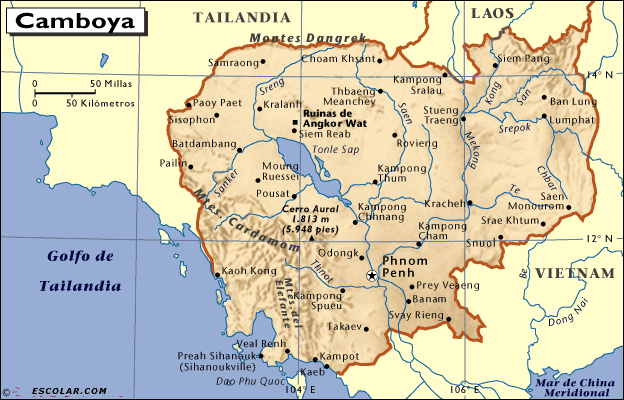
Trade Policy Review: Cambodia

The first review of the trade policies and practices of Cambodia takes place on 1 and 3 November 2011. The basis for the review is a report by the WTO Secretariat and a report by the Government of Cambodia.


Monday, October 24, 2011

WTO releases trade and tariff data for 2010


The WTO released on 21 October 2011 its annual package of trade and tariff data, giving the full picture of trade developments in 2010. This package includes the 2011 editions of its annual publications — International Trade Statistics, Trade Profiles and World Tariff Profiles — plus an update of the WTO Statistics Database and other data sources.

All the data can be downloaded free of charge from the WTO web site’s statistics page: www.wto.org/statistics. A summary of all WTO statistical tools and databases is available here.

International Trade Statistics 2011 provides a comprehensive overview of world trade up to the end of 2010, covering merchandise trade by product and services trade by category. Through the use of extensive charts and maps, the publication illustrates noteworthy trends in global trade with links to numerous tables containing more detailed data.

A methodological chapter explains how the data is compiled while an appendix illustrates historical trends.

International Trade Statistics 2011 serves as an invaluable reference tool for researchers, policy makers and anyone interested in international trade. Redesigned this year to further enhance the presentation of the data, this annual publication is available first in electronic format with a print version to follow in November. Data can be downloaded from the WTO web site in Excel and pdf formats and from the searchable database. PDF versions of the entire report in English, French and Spanish will also be made available on the web site.

To further improve the quality of the publication, we invite you to provide your feedback by filling in the ITS 2011 Survey.
World Tariff Profiles — a joint publication of the WTO, the International Trade Centre (ITC) and the UN Conference on Trade and Development (UNCTAD) — provides comprehensive tariff information on all WTO members and a number of other countries where data is available. It is the only compilation of tariff information of its kind available to researchers and negotiators.

The publication summarizes the market access that each country offers to imports as well as the market access conditions faced by its products in its major export markets. The profiles show both the maximum tariff rates that are legally “bound” in the WTO and the rates that countries actually apply.

PDF versions of World Tariff Profiles 2011 in English, French and Spanish can be downloaded from the WTO web site. The statistical tables are also available in Excel format. In addition, updated Tariff Profiles can be found in the WTO Statistics Database.
Trade Profiles 2011 provides the latest information on trade flows and the trade policy measures of WTO members, observers and other selected economies. With information for each of these provided in a standardized format, the publication is a quick reference tool for anyone looking for essential trade statistics.

The data provided include basic economic indicators (such as gross domestic product or GDP), trade policy indicators (such as tariffs, import duties, the number of disputes, notifications outstanding and contingency measures in force), merchandise trade flows (broken down by broad product categories and major origins and destinations), services trade flows (with a breakdown by major components) and industrial property indicators. With one page devoted to each economy, Trade Profiles offers a concise overview of global trade. PDF versions of the publication in English, French and Spanish can be downloaded from the WTO web site.

Printed versions of World Tariff Profiles and Trade Profiles as well as International Trade Statistics will be available in November in English, French and Spanish and can be ordered from the WTO bookshop.

The WTO Statistics web page also contains updates of Tariff Analysis Online and Tariff Downloads plus new versions of World and Regional Export Profiles (a PDF snapshot of 2010 merchandise exports globally and by region) and World Commodity Profiles (a PDF snapshot of 2010 merchandise exports and imports for agriculture, fuels and mining and manufactured products).

Visitors to the WTO web site may also consult world maps allowing for comparison between countries or customs territories using data of your choice. Options include:
  • trade per capita
  • trade to GDP ratio
  • tariff binding coverage
  • MFN tariffs, simple average, final bound
  • MFN tariffs, simple average, applied
  • MFN tariffs, trade weighted average, applied
  • services sectors with GATS commitments
  • outstanding notifications in the WTO Central Registry
  • merchandise exports
  • merchandise imports
  • commercial services exports
  • commercial services imports
In most cases the data are displayed as a “heat map”. Clicking on a country or territory on the map gives more data. Trade flows (such as merchandise imports and exports) are indicated with arrows.


WTO: 2011 NEWS ITEMS
21 October 2011