Showing posts with label infrastructure. Show all posts

Friday, December 16, 2011

Bolivia.Urban Infrastructure Project

The objective of the Urban Infrastructure Project is to improve the access to basic services to the urban poor in Bolivia (La Paz, El Alto and Santa Cuz) through targeted infrastructure investments and the provision of technical assistance to municipalities in the planning, expansion and sustainability of urban service delivery.

The project consists of three components: 1) urban upgrading in 16 poor neighborhoods in La Paz; 2) improvement of urban mobility in El Alto; and 3)  sanitation improvements in Santa Cruz. The Government of Bolivia (GoB) has requested an even distribution of the available funds for reallocation between components 1 and 2 of the project, to be executed by the Municipality of La Paz and the Municipality of El Alto respectively. This distribution of the funds entails a small risk that the additional allocation for component 2 might not be fully disbursed, given the short period left before the closing date of the credit. The municipal government of El Alto has confirmed they will make every effort to maximize the disbursements under their component.

World Bank.Document Date:  2011/11/16 Document Type:  Project Paper. Report Number:  64949


x

Thursday, December 15, 2011

Spending on Public Infrastructure: A Practitioner's Guide

This paper provides a methodological tool to support the collection and preparation of standardized, comprehensive data regarding public spending on infrastructure services that can be rigorously compared across countries. Infrastructure is defined to cover six sectors: irrigation, energy (primarily power), transport, communication, wastewater management, and water supply.

The guide is designed to provide a much richer and more complete measurement of infrastructure spending than the limited highly aggregated data currently available through the IMF Government Financial Statistics.

Originally developed for Africa, the methodology is relevant and readily applicable to any developing country. With the aim of being as comprehensive as possible, the methodology covers central and sub-national government expenditures, non-budgetary vehicles (such as road funds), state-owned enterprises (SOEs), and public-private partnerships (PPPs).

While the methodology focuses on collecting quantitative data on the level and composition of spending, this is complemented with qualitative data that provides the institutional context. Importantly, the methodology allows for cross-classification of infrastructure spending by purpose (power, roads, etc) and by function (operational versus capital spending).

This guide provides practical guidance -- including concepts, definitions, and classifications -- for each of the three stages of work, namely: (i) pre-field, (ii) field, and (iii) back office.

World Bank.Author:Briceno-Garmendia, Cecilia;Sarkodie, Afua.Document Date:2011/12/01.Document Type:Policy Research Working Paper.Report Number: WPS5905.Volume No 1 of 1


z

Wednesday, December 14, 2011

Viet Nam.Rural Infrastructure Development in Central Highlands

Thematic Classification Economic growth.Capacity Development.Impact Sustained socioeconomic development.Outcome Increased rural productivity.Outputs Improved Productive Rural Infrastructure Increased capacity to efficiently develop, manage and use PRI. 
 
Asian Development Bank.Project Number 40238-02

c

Tuesday, December 13, 2011

China.Gansu Qingyang Urban Infrastructure Improvement Project

Historically speaking, Qingyang is the cradle of Chinese agricultural civilization. There are abundant minerals in it and its surroundings, and great detected reserves of oil, gas and coal, which makes the nation and Gansu locate Qingyang as state strategic energy base and as energy and chemical industry base of Gansu.

The governments of Qingyang and Xifeng district confirm the development strategy that under the guidance of national energy industry tactics and Gansu's development strategy 'the center promoting its wings to flap', they try to shape the Xifeng district into an industrial city that privileges energy and chemistry industry. In order to reinforce this strategy of urban economy development, Qingyang decides to focus on improving, enhancing and expanding Xifeng's urban functions, providing supports for its accelerating further industrialization and urbanization.

According to the general city planning of Qingyang, Xifeng as the central district whose population is at present about 200,000will be expanded to hold 530,000 people. Negative impacts include: noise pollution; soil erosion; construction causes transportation and travel inconvenience; and the smell of sewage from sewage plant influences people's lives. Mitigation measures includes: 1) the new church is located in the new city zone of Qingyang. With the implementation of the planning, public transport could be realized and the traffic inconvenience thus be solved; 2) the execution unit should establish supervisory institutions and strictly follow the 'resettlement plan' to implement compensation and resettlement, and ensure that compensation is paid to the village and individuals; 3) at present the land for relocation has been planned for each village.

The heads should promptly inform the masses; and 4) the execution unit and the municipal planning bureau should determine the resettlement location and resettlement plan as soon as possible in order to accelerate removal.

World Bank.Document Date: 2011/10/19. Document Type.Project Paper.Report Number 65186.Volume No.1 of 2


x

Monday, December 12, 2011

Economic Community of West African States Infrastructure:a regional perspective

Infrastructure improvements boosted growth in the Economic Community of West African States (ECOWAS) by one percentage point per capita per year during 1995-2005, primarily thanks to growth in information and communication technology. Deficient power infrastructure held growth back by 0.1 percent. Raising the region's infrastructure to the level of Mauritius could boost growth by 5 percentage points. Overall, infrastructure in the 15 ECOWAS countries ranks consistently behind southern Africa across many indicators. However, there is parity in access to household services -- water, sanitation, and power. ECOWAS has a well-developed regional road network, though sea corridors and ports need attention. Surface transport is expensive and slow, owing to cartelization, restrictive regulations, and delays.

There is no regional rail network. Air transport has improved despite the lack of a strong hub-and-spoke structure. Safety remains a concern. Electrical power, the most expensive and least reliable in Africa, reaches 50 percent of the population but meets just 30 percent of demand. Regional power trading would bring substantial benefits if Guinea could become a hydropower exporter. Prices for critical ICT services are relatively high. Recent panregional initiatives have improved roaming. New projects are underway to provide access and improved services to unconnected countries. Completing and maintaining ECOWAS's infrastructure will require sustained spending of $1.5 billion annually for a decade, with one-third going to power.

Although the necessary spending is only 1 percent of regional GDP, some countries' share is between 5 and 25 percent of national GDP. Clearly, external assistance will be needed

World Bank.Author:  Ranganathan, Rupa;Foster,Vivien. Document Date:2011/12/01.Document Type:  Policy Research Working Paper.Report Number:  WPS5899. Volume No: 1 of 1

ECOWAS's infrastructure: a regional perspective
x

The Southern African Development Community infrastructure:a regional perspective

Infrastructure improvements boosted growth in the Southern African Development Community (SADC) by 1.2 percentage points per capita per year during 1995-2005, mainly from access to mobile telephony. Road network improvements made small growth contributions, while power sector inadequacy had a negative impact. Infrastructure improvements that matched those of Mauritius, the regional leader, could boost regional growth performance by 3 percentage points. SADC's 15 member countries include small, isolated economies with island states, a mix of low- and middle-income countries, and larger countries with potentially large economies.

The economic geography reinforces the importance of regional infrastructure development to create a larger market and greater economic opportunities. The region's infrastructure indicators are high for Africa. The regional road network is well-developed, and surface transport is comparatively cheap, but subject to delays and long-haul fees. An extensive railway system competes directly with road transport. With integration and improvements, SADC's ports could form an effective transshipment network. Air transport, dominated by South Africa, is the best in Africa. Electricity in southern Africa is well developed; the region leads Africa in generation capacity and low rates, but access is limited.

ICT services are the most accessible among the regions, though expensive. Landlocked countries still need to be connected, and greater competition is needed to reduce costs. Completing and maintaining SADC's infrastructure will require $2.1 billion annually for a decade. For small countries, and large countries with small revenues, the burden may be insurmountable without external assistance.

World Bank.Author:  Ranganathan, Rupa ; Foster, Vivien.Document Date:  2011/12/01.Document Type:  Policy Research Working Paper.Report Number:  WPS5898. Volume No: 1 of 1

a

Armenia Kotayk Solid Waste Management Project

The EBRD is considering providing a €3.5 million sovereign loan to the Republic of Armenia for the construction of the first EU compliant regional landfill and relevant infrastructure in the country. The landfill will be located in Hrazdan, capital town of Kotayk distrcit in the central part of Armenia, and will be used by eight municipalities in the nearby region - Hrazdan, Abovian, Charentsavan, Yeghvard, Nor Hachn, Tsakhadzor, Byureghavan and Sevan (Participating Municipalities). The project will require the tendering out of waste collection to the private sector and the creation of a fully commercial solid waste management company (the “Company”).

The project will also include the aquisition of vehicles, bins and equipment for waste management. 

European Bank for Reconstruction and Development.Country: Regional.Project number:39603.Business sector: Municipal and environmental infrastructure. Public .Environmental category:A Board date:17 Apri 2012.Status: Signed. PSD disclosed:8 Dec 2011


x

Tuesday, December 6, 2011

The project Chile Infrastructure for Territorial Development has changed to Closed

World Bank.The project Chile Infrastructure for Territorial Development has changed to Closed. To see more information, see the project information in the World Bank project database the project information in the World Bank project database

The Infrastructure for Territorial Development Project for Chile aims to increase the effective and productive use of sustainable infrastructure services by poor rural communities in selected territories o f the regions of Coquimbo, Maule, BioBio, Araucania, and Los Lagos (or any other region as may be proposed by the Borrower and agreed to by the Bank).

The project has the following three components: Component 1) will assist local stakeholders and regional government agencies to: (a) prepare in prioritized rural territories in the five eligible regions development framework plans, (b) identify demands for improved infrastructure services, and (c) monitor progress with plan implementation. Component 2) will support: (a) feasibility and design studies of subproject proposals to submit for financing under this component, (b) rehabilitation of rural roads and construction, rehabilitation and expansion of rural water, sanitation, electricity and ICT infrastructure, (c) supervision of the mentioned works, and (d) studies and support for the establishment and strengthening of local service providers to operate, maintain and administer the services to achieve quality and sustainability.

Component 3) will support: (a) project coordination units at national and regional levels, (b) implementation of studies and capacity building to strengthen policies and institutions in areas of territorial planning and rural infrastructure service delivery (including those related to the application of social and environmental safeguards), and (c) project monitoring, evaluation and learning as a contribution to national level expansion of the program.

c

Friday, December 2, 2011

Sierra Leone Infrastructure Development Fund

Approval Date 14-OCT-2011.Closing Date N/A.Total Project Cost** .75. Region Africa. Major Sector (Sector) (%) Energy and mining (General energy sector) (100%).Themes (%) Infrastructure services for private sector development (100%).Environmental Category C.Bank Team Lead Imran, Mudassar Borrower/Recipient GOVERNMENT OF SIERRA LEONE. Implementing Agency MINISTRY OF ENERGY AND WATER RESOURCES


Monday, November 28, 2011

Nicaragua.Rural Roads Infrastructure Improvement Project

The development objectives of the Rural Roads Infrastructure Improvement Project for Nicaragua are to (a) improve the access of the rural population living in the project areas to markets and social and administrative services through: (i) the carrying out of improvements in the recipient's road infrastructure; and (ii) the strengthening of Ministry of Transport and Infrastructure's (MTI's) institutional capacity for asset and disaster risk management; and (b) support the generation of short-term employment opportunities for the rural population living in the project areas.

There are three components to the project. The first component is rural road improvements and maintenance. This component comprises carrying out of improvement works (such as cobblestone surfacing or any other viable surface replacement option acceptable to the Association) in selected rural roads, all within the existing right of way; and carrying out of periodic maintenance works (such as asphalt resurfacing) in selected road sections within the national trunk road network, all within the existing right of way.

The second component is institutional development. This component comprises three sub-components: strengthening of MTI's institutional capacity; strengthening of Road Maintenance Fund (Fondo de Mantenimiento Vial) (FOMAV's) institutional capacity; and specific studies and designs. The third component is project management. This component comprises provision of support for project implementation, supervision and strengthening of MTI, through, inter alia: (i) the financing of consultant services; and (ii) the carrying out of evaluation studies to monitor the project's implementation.

World Bank.Document Date:2011/11/10.Document Type:Project Appraisal Document.Report Number:61418.Volume No:1 of 1

Nicaragua - Rural Roads Infrastructure Improvement Projecth

Friday, November 25, 2011

México.Mareña Renovables Wind Projec

The Project consists in the construction of a 392MW wind project in Oaxaca sponsored by the Macquarie Mexican Infrastructure Fund. The Project will supply energy to Fomento Económico Mexicano, S.A.B. de C.V. (FEMSA) under the ¿Self-Supply¿ legal framework

ME-L1107: Mareña Renovables Wind Projecta

Thursday, November 24, 2011

Uruguay to improve Montevideo drainage infrastructure with IDB support

IDB.News Releases.Nov 23, 2011. Loan for $20.5 million will directly benefit 4,500 people in three critical neighborhoods and in adjacent areas affected by floods. The Inter-American Development Bank (IDB) approved a loan for $20.5 million to finance the improvement of urban drainage infrastructure in Uruguay’s capital of Montevideo. The project will benefit some 4,500 people as well as protect adjacent areas from environmental degradation and urban flooding caused by wastewater and storm water.

The project aims to minimize impacts caused by the lack or inadequacy of urban drainage, mainly in the upper basin of the Arroyo Seco (Krüger Barrio), the upper basin of the Arroyo Quitacalzones (Jacinto Vera Barrio) and the Cañada Peabody basin (Barrio Lezica) in the Uruguayan capital. These neighborhoods are periodically affected by floods. In addition, water and sanitation works will be funded in the Cerro Industrial Technology Park.

"Prioritizing individual projects will make it possible to increase the capacity of existing infrastructure and extend storm sewer service to urban areas heavily impacted by the floods," said Sergio Campos, IDB project team leader.

The project will consist of constructing storm water drainage works, including flood buffer ponds, conduits to increase the capacity of spillways to drain excess water, and complementary structures.

The neighborhoods where the works will be carried out were prioritized according to frequency of flooding as well as degree of impact on residents, houses, and streets.

The operation will also finance the installation and equipping of 12 hydro-meteorological stations to strengthen the city’s rain gauge network.The stations will provide information useful in the design of future works and the detection of changes in rainfall patterns that could be associated with the effects of climate change.

The IDB loan for $20.5 million was extended for a term of 25 years with a four-year grace period and a variable interest rate based on LIBOR. Local counterpart financing totals $10 million.
a

Tuesday, November 22, 2011

Botswana's infrastructure: a continental perspective

Infrastructure made a net contribution of just over two percentage points to Botswana's improved per capita growth performance in recent years. Raising the country’s infrastructure endowment to that of the region's middle-income countries could boost annual growth by about 1.2 percentage points. Botswana has made significant infrastructure progress in recent years, spanning the transport, water and sanitation, power, and mobile telephony sectors. But the country still faces a number of important infrastructure challenges.

The most pressing is in the power sector, where the country is economically and financially exposed to a lack of generation capacity and insufficient power supply, leaving the economy vulnerable to power price shocks and load shedding. Botswana's international transport connections and Internet connectivity also lag behind those of comparable countries. Botswana's overall resource envelope of $800 million per year surpasses its $785 million needs estimate.

Nevertheless, it loses $68 million a year to inefficiencies and faces a funding gap of $305 million per year, entirely in the power sector, traceable to the quality of spending decisions. Botswana will be in a good position to meet its infrastructure goals if it can reduce inefficiencies, increase public-sector receipts, and attract more public funding.

Author: Dominguez-Torres,Carolina;Briceno-Garmendia,Cecilia.Document Date:2011/11/01.Document Type:Policy Research Working Paper.Report Number:WPS5887. Volume No: 1 of 1

MEPs show support for single European rail area

Brussels, 15.11.2011. COM(2011) 749 final.COMMUNICATION FROM THE COMMISSION TO THE EUROPEAN PARLIAMENT, THE COUNCIL, THE EUROPEAN ECONOMIC AND SOCIAL COMMITTEE AND THE COMMITTEE OF THE REGIONS.Building an open and secure Europe: the home affairs budget for 2014-2020 {SEC(2011) 1358 final} {SEC(2011) 1359 final}. Parliament approves the Commission’s proposal to liberalise rail services and calls for a plan for managing rail infrastructure and services, and the opening of rail passenger markets to competition.

The creation of an area of freedom, security and justice is a cornerstone of the European project. Home affairs policies contribute to this project by shaping a Europe where persons can enter, move and live freely, confident that their rights are respected and their security assured. An integrated approach to migration and security can bring benefits to the EU and its non-EU partners. The growing importance of home affairs policies has been confirmed by the Stockholm Programme1 and its Action Plan2. This is also one of the areas which have seen important changes under the Lisbon Treaty3. In the field of internal security, the Commission's communication on the Internal Security Strategy in Action4 identifies clear strategic goals and provides a basis for concerted action to address common security challenges in the years to come. Through cooperation and solidarity at EU level and with non-EU countries, substantial progress has been made towards creating a more open and secure Europe.

In spite of this progress, Europe still faces many challenges. A comprehensive, coherent and effective response is needed to the challenge of migration. Citizens also expect the Union to contribute to providing security by combating organised crime, terrorism and other threats. The EU budget plays an essential role in turning the Union's home affairs objectives into tangible results. The creation of an area of freedom, security and justice is achieved by means of a range of 'tools' including spending programmes, networks, large-scale IT systems and EU agencies.

In its Communication of 29 June 2011 on the next Multiannual Financial Framework5, the Commission proposed a home affairs budget of €10.9 billion (current prices) for the period 2014-2020 which represents a continuation of the level of spending foreseen at the end of the 2007-2013 financial framework and remains below 1% of the overall EU budget. Building on evaluation results and stakeholder consultation, the design of the next Multiannual Financial Framework is an opportunity to better align spending at EU level with the Union's strategic policy objectives. Crucially, it is also a chance to improve and simplify the way funding is delivered. This Communication sets out how the Commission has grasped these opportunities in the home affairs area.

Monday, November 21, 2011

Mozambique's infrastructure: a continental perspective

In the last 10 years, Mozambique's economy has grown steadily at an impressive rate of 7.7 percent per year, driven by the service sector, light industry, and agriculture. This pace is expected to continue or even increase with the massive influx of already-planned investment on the order of $15-20 billion.

Mozambique's infrastructure is well developed in some sectors, including its east-west transport infrastructure, power grid, and water and sanitation networks. But the nation still faces critical challenges in these and other areas, including developing north-south transport connections, properly managing the water system, and expanding hydroelectric generation to meet potential.

Mozambique spent about $664 million per year on infrastructure during the late 2000s, with as much as $204 million lost annually to inefficiencies. Comparing spending needs with existing spending and potential efficiency gains leaves an annual funding gap of $822 million per year.

Mozambique could reduce inefficiency losses by positioning itself as a key power exporter. The country could reach infrastructure targets in 20 years through a combination of increased finance, improved efficiency, and cost-reducing innovations.

Author: Dominguez-Torres, Carolina ; Briceno-Garmendia, Cecilia. Document Date:2011/11/01.Document Type:  Policy Research Working Paper.Report Number:  WPS5885. Volume No:1 of 1

Monday, November 14, 2011

Brazil to complete São Paulo beltway with $1.15 billion loan from the IDB


The Inter-American Development Bank (IDB) announced today the approval of a $1.15 billion loan for the construction of the 44-kilometer North section of the Mário Covas Rodoanel highway in São Paulo. This section will complete the177-kilometer multiple-lane beltway, one of the largest and most critical transportation infrastructure projects ever undertaken in Brazil.

In construction for more than a decade, the Rodoanel is already improving the efficiency of transportation for both cargo and passengers, reducing traffic congestion and pollution and improving the quality of life and productivity in the São Paulo metropolitan region.

“With the North section of Rodoanel ready, a major portion of the heavy traffic going to the port of Santos, MERCOSUL and other regions of the country will no longer have to cross the city, therefore reducing congestion,” said Vera Lucia Vicentini, IDB specialist and project team leader. “The population of the entire metropolitan area will enjoy better mobility and better connectivity, not to mention increased safety during their trips.”

The Greater São Paulo Region faces serious congestion problems for several reasons, including a 5 percent annual growth rate in vehicle traffic in the metropolitan area and the radial-type design of the 10 major highways in the area, which force 1 million vehicles to ride through the middle of the city each day. The two main thorough fares in São Paulo—Marginal Tietê and Marginal Pinheiros—are saturated with traffic 60 percent of the time and suffer numerous accidents.

Together with Ferroanel, a railroad beltway, and the creation of integrated logistics centers, the Rodoanel project should also improve access to major production and trading areas, as well as international connection centers, thus reducing travel times, lowering transportation costs and improving productivity.
The North Section is expected to be completed in November 2014, with financing from three sources: $1.15 billion in IDB funds, $980 million from the federal government and $890 million from the São Paulo state government. The North section will link the edge of the East section—at the intersection with Presidente Dutra highway—with Raimundo Pereira de Magalhães Avenue, at the beginning of the West section.

There will also be interconnections to Guarulhos International Airport and the Fernão Dias highway.

Following the completion of the North section, a drop of 10 percent in the average daily volume of traffic is expected for the first year of operation, reaching a total drop of 13 percent by 2024. This could result in a 17 percent increase in average vehicle speeds. Moreover, the North section should contribute to a reduction of around half a million tons per year in carbon dioxide emissions and an 18 percent decrease in particle materials generated by the traffic in Marginal Tietê.

The IDB loan is for 25 years, with a five-year grace period and a variable interest rate based on LIBOR.


IDB. News Releases.Nov 8, 2011

Tuesday, November 8, 2011

China-Xinjiang Yining Urban Transport Improvement Project

Yining proposed to the Bank team a package of urban transport investments, including the construction of new roads and improvement of existing roads, the provision of public transport infrastructure and services, and the improvement of traffic management and road safety.
According to the proposal and the Bank team#s assessment, it is proposed that the focus of the project is to provide the basic urban transport infrastructure and equipments to support the socialand economic development of Yining, meanwhile introducing modern traffic management concept and techniques to ensure the sustainability of development.

Yining´s existing central city area has a relatively adequate urban road network, but their functioning is being compromised by the severe deterioration and the lack of Non MotorizedTransport (NMT) facilities or auxiliary facilities such as lighting and greening. It is recommended that these roads should be rehabilitated to improve the living conditions of the local residents.

The two new development zones to the east and west of the existing city area are rapidly growing, thus new roads are needed to support their development. However, the road function should be well-defined to determine the cross section design instead of simply building wide roads as proposed by the city.

Public transport service in Yining is far from being attractive and convenient. There are only 14 bus lines in operation and 299 buses in total, many of which are rather decrepit. Insufficient public transport facilities are another constraint to the further development of public transport in Yining. Moreover, the city currently has no advanced systems for bus ticketing, dispatching or operation.

Traffic management capacity is relatively low, leading to the under-utilization of the existing road capacity and causing safety issues. Even with a small number of vehicle ownership of about 50,000, the city is starting to face congestions. A high fatality rate of 107 fatalities per million population is registered in 2010.

In response to these challenges, the Bank revised the proposal with Yining and tentatively agreed that the project will include the following 4 components.
Document Date. 2011/11/03.Document Type.Integrated Safeguards Data Sheet.Report Number.AC6497.Volume No 1 of 1

Complete Report
Official version of document (may contain signatures, etc)

Thursday, November 3, 2011

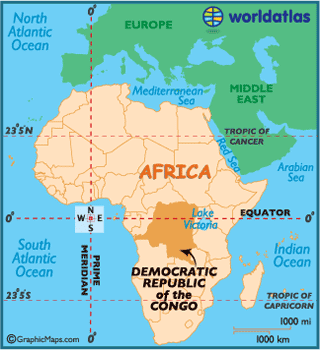
The Democratic Republic of Congo's Infrastructure

The Democratic Republic of Congo (DRC) faces possibly the most daunting infrastructure challenge on the African continent. Conflict has seriously damaged most infrastructure networks. Vast geography, low population density, extensive forestlands, and criss-crossing rivers complicate the development of new networks. Progress has been made since the return of peace in 2003.

A privately funded GSM network now provides mobile telephone signals to two-thirds of the population. External funding has been secured to rebuild the country's road network, and domestic air traffic has grown. Modest investments could harness inland waterways for low-cost transport. Much more substantial investments in hydropower would enable the DRC to meet its own energy demands cheaply while exporting vast quantities of power. One of the country's most immediate infrastructure challenges is to reform the national power utility and increase power generation and delivery. Capacity must increase by 35 percent over the period 2006-15 to meet domestic demand. The dilapidated condition of both road and rail infrastructure presents another challenge.

To meet the target defined in the report, investment in the country's infrastructure must increase from $700 million to $5.3 billion per year over the next decade, a staggering 75 percent of 2006 GDP. New infrastructure technologies, the elimination of inefficiencies, and cross-border finance (for hydropower development) could cut the annual funding gap in half. Recently, the country secured $4 billion in external finance commitments for infrastructure, enabling increases in budget allocations for public investment.

Author: Foster,Vivien;Benitez,Daniel Alberto.Document Date: 2011/03/01.Document Type: Policy Research Working Paper.Report Number: WPS5602.Volume No:  1 of 1

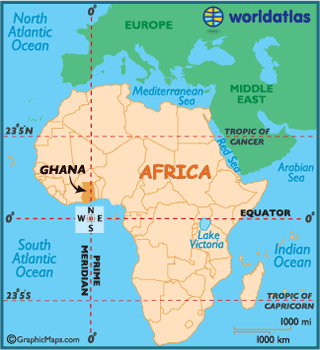
Ghana's Infrastructure

Infrastructure contributed just over one percentage point to Ghana's annual per capital GDP growth during the 2000s. Raising the country’s infrastructure endowment to that of the region's middle-income countries could boost the annual growth rate by more than 2.7 percentage points. Ghana has an advanced infrastructure platform when compared with other low-income countries in Africa. The country’s coverage levels for rural water, electricity, and GSM signals are impressive.

A large share of the road network is in good or fair condition. Institutional reforms have been adopted in the ICT, ports, roads, and water supply sectors. Ghana’s most pressing challenges lie in the power sector, where outmoded transmission and distribution assets, rapid demand growth, and periodic hydrological shocks leave the country reliant on high-cost oil-based generation. Exceptionally high losses in water distribution leave little to reach end customers, who are thus exposed to intermittent supplies. Addressing Ghana's infrastructure challenges will require raising annual expenditures to $2.3 billion.

The country already spends about $1.2 billion per year on infrastructure, equivalent to about 7.5 percent of GDP. A further $1.1 billion is lost each year to inefficiencies, notably underpricing of power.Ghana's annual infrastructure funding gap is about $0.4 billion per year, chiefly related to power and water. Following its recent oil discoveries, Ghana can raise additional public funding from increased tax receipts. The country has several strong areas on which to build and a solid economic base from which to fund incremental efforts.

Author: Foster,Vivien; Pushak, Nataliya;Document Date: 2011/03/01.Document Type:Policy Research Working Paper.Report Number:WPS5600.Volume No: 1 of 1

Zambia's Infrastructure

Infrastructure improvements contributed 0.6 percentage points to Zambia's annual per capital GDP growth over the past decade, mostly because of exponential growth in information and communication services. The power sector, by contrast, pulled the growth rate down by more than 0.1 percentage points. Improving Zambia's infrastructure endowment could boost growth by up to 2 percentage points per year.

 Zambia's relatively high generation capacity and power consumption are accompanied by fewer power outages than elsewhere in the region. But Zambia's power sector emphasizes the mining industry, while household electrification is about half that in other resource-rich countries. Zambia's power tariffs, among the lowest in Africa, are less than half the level needed to accelerate electrification and keep pace with mining sector demands. In power as in just about every other aspect of infrastructure, rural Zambians lag well behind their African peers. In a country where 70 percent of the population depends on agriculture for its livelihood, this represents a huge drag on the economy.

Zambia would need to spend an average of $1.6 billion a year over the decade 2006-15 to develop the infrastructure found in the rest of the developing world. This is equivalent to 20 percent of Zambia's GDP and about double the country's rate of investment in recent years. Closing the country's annual infrastructure funding gap of $500 million requires raising more funds, looking for more cost-effective ways to meet infrastructure targets, and eliminating the inefficiencies that cause the loss of $300 million annually

Author:  Foster,Vivien ;Dominguez, Carolina.Document Date:  2011/03/01.Document Type:Policy Research Working Paper.Report Number: WPS5599.Volume No: 1 of 1